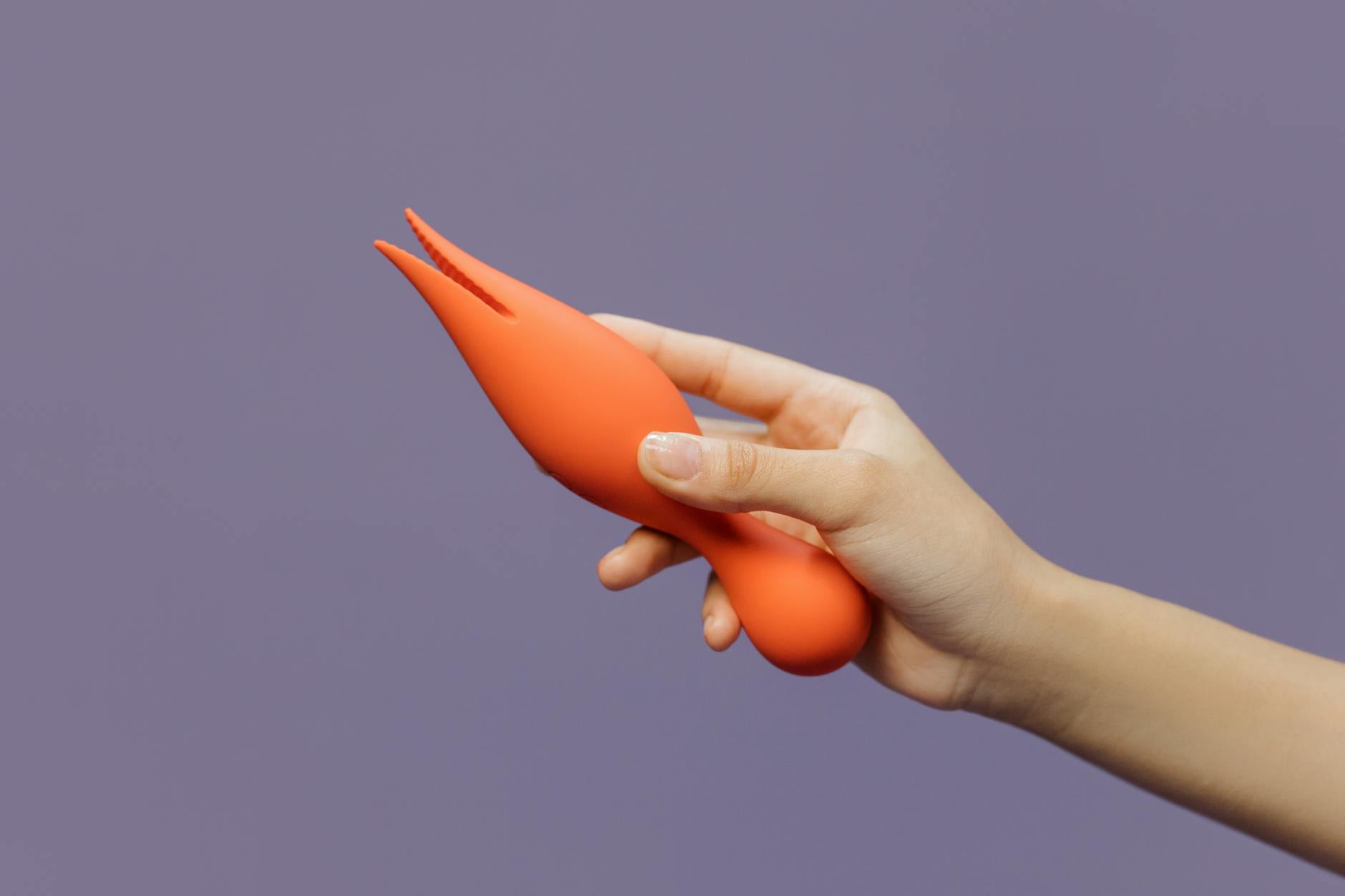
Your hormones change every week. Your sensitivity changes every week. Your desire, your arousal speed, your ability to orgasm, your preferred intensity, even your lubrication. All of it shifts. Yet most people treat their lemon vibrator the same way day in and day out, wondering why some days it feels amazing and other days it feels like almost nothing.
Estrogen and testosterone shift in a roughly four-week pattern (though cycles vary wildly, and that's fine). These hormones don't just affect your uterus. They affect blood flow to your genitals, how quickly your nervous system responds to touch, how much natural lubrication your body produces, and how sensitive your clitoris is to stimulation.
The best part? Once you know the pattern, you can adjust how you use your lemon vibrator or clitoral vibrator to match where you are. You're not broken on the days when things feel off. You're just on a different setting.
Your estrogen and testosterone are at their lowest. This is when your clitoris is least sensitive, and many people find their sensation is muted. Some folks have zero interest in pleasure during their period. Others find that the right kind of stimulation feels incredible because the pelvic floor is more tense and needs release.
If you want to use your lemon vibrator during menstruation, start at intensity 1 or 2. Your tissue is more prone to cramping and sensitivity right now, so gentler suction works better than during other phases. Many people find that the rhythmic sensation of a clitoral vibrator actually helps with period cramps, not makes them worse.
The key: slower warm-up. Give yourself 15-20 minutes. Your body won't race to arousal right now, and that's completely normal. If penetrative sex is happening, you might need more lubrication than usual despite higher natural blood flow to the area.
Estrogen starts climbing. Your clitoris becomes noticeably more sensitive. You're more likely to want pleasure, you'll warm up faster, and your body will produce more natural lubrication. This is the sweet spot for most lemon vibrators and clitoral vibrators. You're ramping up, and your nervous system is cooperating.
Here's where you can bump up intensity. If intensity 2 felt good during your period, try 3 or 4 now. Your tissue can handle more sensation. Your arousal will build faster, so you might need less warm-up time. Some people find they can reach orgasm during this phase with almost half the time or stimulation they'd need during menstruation.
This is also when many people have more interest in partnered pleasure or trying new patterns on their lemon vibrator. You have more energy, more desire, more patience for exploration.
Your testosterone peaks right before ovulation. This is the most horny phase for most people. Your clitoris is maximally sensitive. Your natural lubrication peaks. Arousal comes fast. This is when you might actually need to dial back intensity slightly, because overstimulation feels less good and more raw.
Your lemon vibrator or any clitoral vibrator can go to higher intensity settings during this window, but many people find that what they actually want is speed and pattern variation rather than raw power. You might switch between intensity 3 and 5 instead of staying locked on one setting. Your body can handle nuance right now.
Orgasms tend to be easiest during this phase. Some people have multiple. Some people orgasm faster than at any other time. This isn't magic. It's just biology showing up.
Progesterone rises. Estrogen dips slightly. Your sensitivity flattens compared to ovulation, but it's still higher than during menstruation. This phase is wildly variable depending on whether you're in the early luteal (days 16-21) or late luteal (days 22-28).
Early luteal feels pretty good. You're still reasonably sensitive. Intensity 3 or 4 on your lemon vibrator works well. You might need a bit longer to warm up than during ovulation, but not as long as menstruation.
Late luteal (the week before your period) is when progesterone peaks and your sensitivity drops again. You might need longer warm-up, lower starting intensity, and more time overall. Some people find that later in this phase they lose interest entirely in pleasure, and that's not a sign anything is wrong. It's just where you are.
If you have premenstrual symptoms, an orgasm can sometimes help ease them. Sometimes a lemon vibrator is exactly what you need. Other times you need sleep more than you need pleasure. Listen to that.
You don't need to track your cycle obsessively to notice patterns. Most people can feel the difference: days when their clitoris feels supersensitive, days when it feels numb, days when arousal races and days when it crawls.
Here are four things to actually do:
Adjust your starting intensity. If you always start at intensity 3, try intensity 2 during menstruation and late luteal. Try intensity 4 during ovulation. Your lemon vibrator has multiple settings for a reason.
Budget time differently. During high-sensitivity phases, you might need 10 minutes. During low-sensitivity phases, 20-25 minutes. Neither is normal or abnormal. Both are fine.
Pay attention to lubrication. Mid-cycle you'll produce more. During menstruation and late luteal you might need added lubrication even though your body is still capable of self-lubrication. This isn't a problem to fix. It's just information.
Notice your actual preferences. If you hate partnered sex during your period but love solo pleasure, that's data. If you want your partner involved only during ovulation, that's data too. Your body is telling you something useful.
Stress, sleep, medications, birth control, and about seventeen other factors shift your cycle and your sensitivity. Some months your follicular phase feels amazing. Other months it feels flat. That's not failure. That's just bodies being variable.
If you have PCOS or endometriosis or irregular cycles, the traditional four-phase model might not describe your actual experience. The principle still holds: notice what your body is doing and adjust accordingly. You don't need to fit the cycle. You just need to notice your own pattern.
Birth control absolutely changes this equation. Hormonal IUDs, pills, and implants all affect your hormonal fluctuations differently. Some completely flatten your cycle. Some create smaller swings. If you're on hormonal birth control, you might still notice monthly variations, or you might not. Either way is normal.
Most advice about pleasure treats your body like it's static. Use intensity 4, always. Warm up for 10 minutes, always. Have an orgasm goal, always. But your body isn't static. It's a system that shifts based on hormones, stress, sleep, and a thousand other things.
Once you stop expecting consistency and start expecting variation, everything gets easier. You're not failing on days when your lemon vibrator feels less responsive. You're just on a different phase. You adjust your technique, your timing, your intensity, and you move on.
This is actually the opposite of frustrating. It's freeing. Because it means there's no "right" way to use a clitoral vibrator. There's just the way that works for where you are right now.
Yes, absolutely. Many people find it helpful. Start at a lower intensity than you'd normally use. You might need more lubrication, and you might need longer to warm up. Some people find it actually helps with cramps. Others prefer not to. Both are fine.
Completely. Hormonal birth control flattens your hormonal fluctuations, which means your sensitivity might stay more consistent throughout the month. You might not notice the huge swings between phases. You might also need to adjust your baseline intensity compared to before birth control. It's not universal, though. Some people feel no difference.
Your clitoris has fewer nerve endings during low-estrogen phases of your cycle. You're not broken. Your body is just less sensitive to light touch right now. Switch to a higher intensity, take longer to warm up, or choose a phase when sensitivity is higher if it matters for your pleasure.
You likely still have hormonal fluctuations. You just might not notice a monthly pattern. Pay attention to your own variation instead of trying to fit a textbook cycle. That's equally valid.
No. Your lemon vibrator is fine. What changes is how you use it. Switch intensity settings. Adjust your warm-up time. Vary how long you spend. The toy stays the same. Your approach shifts.
Completely. Hormones affect blood flow, sensitivity, arousal speed, and pelvic floor tension. Some phases make orgasms easy. Other phases make them take longer or feel less intense. Some phases you might not want an orgasm at all. All of this is normal variation.
Your body is cyclic. Your pleasure is cyclic. Your lemon vibrator isn't the variable. How you use it is. Once you notice your own pattern and adjust accordingly, everything clicks. You're not fighting your body anymore. You're just working with where you actually are.
Goldey, K. L., & van Anders, S. M. (2011). Sexual thoughts: Associations with hormonal contraceptive use and hormonal fluctuations. Archives of Sexual Behavior, 40(2), 313-325.
Bullivant, S. B., Sellergren, S. A., Stern, K., Spencer, N. A., Jacob, S., Mennella, J. A., & McClintock, M. K. (2004). Women's sexual experience during the menstrual cycle: Identification of the sexual phase by noninvasive measurement of luteinizing hormone. Journal of Sex & Marital Therapy, 30(1), 25-49.
Meßner, M., & Saal, W. (2016). Hormones and sexuality: What do we know about cycle-related changes in sexual experience? Journal of Sex & Marital Therapy, 42(2), 146-172.